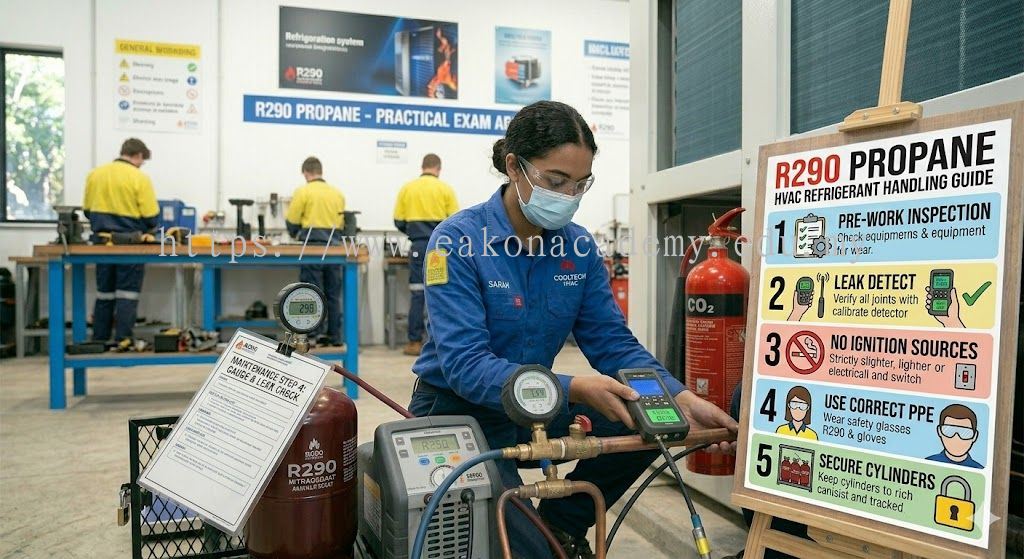
PROPANE HVAC REFRIGERANT HANDLING GUIDE – SAFE OPERATING PROCEDURES, R290 MANAGEMENT PRACTICES AND PROFESSIONAL HVAC TRAINING STANDARDS
Propane HVAC refrigerant handling guide is an important reference for modern refrigeration and air conditioning professionals as the HVAC industry continues to adopt natural refrigerants with lower environmental impact. Propane refrigerant, commonly known as R290, is increasingly used in HVAC systems because of its excellent energy efficiency, strong cooling performance, and extremely low global warming potential (GWP). However, as an A3 classified highly flammable refrigerant, propane requires specialized handling knowledge, proper safety procedures, and professional technician training. For HVAC technicians, refrigeration engineers, and organizations seeking technical expertise, eakonacadem.edu.my provides structured training and education focused on propane refrigerant safety, handling techniques, and modern HVAC industry requirements.
The importance of a propane HVAC refrigerant handling guide lies in ensuring that technicians understand the correct procedures for working with flammable refrigerants. Unlike traditional refrigerants, propane requires additional safety controls due to its flammability characteristics. Improper handling can result in refrigerant leaks, fire hazards, equipment damage, or unsafe working conditions. A comprehensive handling guide helps technicians apply safe practices during installation, servicing, maintenance, recovery, storage, and system operation.
One of the key components of a propane HVAC refrigerant handling guide is understanding the properties and characteristics of R290 refrigerant. Technicians must understand its flammability classification, pressure characteristics, operating behavior, and environmental advantages. This knowledge allows technicians to identify potential hazards and apply appropriate safety measures when working with propane-based HVAC systems.
Proper workplace preparation is another important part of propane refrigerant handling procedures. Before starting any HVAC work, technicians must conduct a risk assessment to identify possible hazards within the working area. The service environment should have adequate ventilation and must be free from ignition sources such as open flames, sparks, welding equipment, and unsuitable electrical devices. Proper preparation reduces the possibility of accidental ignition and ensures a safer working environment.
Safe handling of propane refrigerant requires the use of suitable tools and equipment. A propane HVAC refrigerant handling guide emphasizes the importance of using approved charging equipment, leak detectors, recovery machines, vacuum pumps, and measuring instruments designed for hydrocarbon refrigerants. Using incorrect tools may create ignition risks or affect system performance. Proper equipment selection ensures safer and more accurate HVAC servicing.
Refrigerant charging procedures are another critical aspect of propane HVAC refrigerant handling. Technicians must use precise weighing methods to ensure the correct refrigerant charge according to manufacturer specifications. Overcharging or undercharging can affect system efficiency, operating pressure, and overall safety. Accurate charging practices help maintain reliable system performance while reducing operational risks.
Leak detection and prevention are essential parts of propane refrigerant management. Technicians must inspect refrigeration components such as piping connections, valves, compressors, and joints to identify possible leaks. Professional leak detection tools should be used to verify system integrity. Any refrigerant leaks must be repaired immediately to prevent propane accumulation and potential safety hazards.
Recovery and maintenance procedures are also included in a complete propane HVAC refrigerant handling guide. Technicians must understand how to safely recover propane refrigerant using appropriate equipment and approved storage methods. Proper recovery practices prevent unnecessary refrigerant release and support environmentally responsible HVAC operations.
Storage and transportation safety are additional areas covered in propane refrigerant handling practices. Propane cylinders must be stored in suitable locations with proper ventilation, away from heat sources and ignition risks. During transportation, cylinders must be secured correctly to prevent damage or accidental release. Following proper storage and transport procedures ensures safer refrigerant management throughout the supply chain.
Personal protective equipment (PPE) is another important consideration when handling propane refrigerant. Technicians should use appropriate protective equipment such as gloves, safety goggles, anti-static clothing, and suitable footwear. PPE provides additional protection against refrigerant exposure, cold injuries, and workplace hazards.
Professional training is essential for ensuring technicians can apply a propane HVAC refrigerant handling guide effectively. Institutions such as eakonacadem.edu.my provide comprehensive HVAC training programs focused on natural refrigerants, R290 safety procedures, system servicing techniques, and industry best practices. Through structured technical education, technicians gain the knowledge and practical skills required to work safely with propane refrigerant systems.
For HVAC companies and refrigeration operators, implementing proper propane refrigerant handling procedures provides many benefits, including improved workplace safety, reduced operational risks, enhanced system reliability, and better compliance with industry requirements. Properly trained technicians help organizations successfully transition toward environmentally sustainable refrigeration solutions while maintaining safe and efficient operations.
In conclusion, a propane HVAC refrigerant handling guide is essential for ensuring the safe and professional use of R290 refrigerant in modern HVAC systems. As the demand for low-GWP refrigerants continues to increase, proper handling knowledge becomes increasingly important. Through risk assessment, correct equipment usage, safe charging methods, leak prevention, recovery procedures, storage control, and professional training, propane refrigerant systems can be managed safely and effectively. eakonacadem.edu.my supports the development of skilled HVAC professionals by promoting safety education, technical training, and industry best practices, contributing to a safer, more efficient, and environmentally responsible refrigeration industry in Malaysia and beyond.
Lihat detail lebih lanjut tentang EAKON ACADEMY SDN BHD Malaysia