
Green Technology Refrigerant Management Malaysia: Driving Sustainable HVACR Innovation, Low-Carbon Solutions, and Environmental Excellence
Green Technology Refrigerant Management Malaysia refers to the integration of advanced green technologies, sustainable practices, and environmentally responsible methods in managing refrigerants within HVACR (Heating, Ventilation, Air Conditioning, and Refrigeration) systems in accordance with Malaysia’s environmental and sustainability objectives. As Malaysia continues to promote green technology adoption and reduce national carbon emissions, green technology refrigerant management has become a key component in achieving energy efficiency, environmental protection, and sustainable development across all industries. Refrigeration and air conditioning systems are widely used in commercial buildings, industrial facilities, hospitals, hotels, supermarkets, cold storage warehouses, data centers, and residential applications. Without proper management, refrigerants with high Global Warming Potential (GWP) can contribute significantly to climate change. Therefore, green technology refrigerant management Malaysia plays a vital role in ensuring environmentally responsible HVACR operations.
Green technology refrigerant management focuses on applying innovative and eco-friendly technologies to minimize refrigerant emissions, improve system efficiency, and support sustainable cooling solutions. This includes the use of advanced leak detection systems, energy-efficient HVACR equipment, low-GWP refrigerants, smart monitoring systems, and environmentally optimized maintenance practices. The primary goal is to reduce the environmental impact of refrigeration systems while enhancing performance, reliability, and long-term sustainability.
One of the most important aspects of green technology refrigerant management Malaysia is the adoption of advanced leak detection and monitoring systems. Modern HVACR systems utilize electronic sensors, infrared detection technology, ultrasonic devices, and IoT-based monitoring systems to continuously track refrigerant performance. These technologies provide real-time alerts when leaks or system inefficiencies occur, allowing technicians to respond quickly and prevent significant refrigerant loss. This proactive approach reduces greenhouse gas emissions and improves overall system reliability.
Another key component is the use of low Global Warming Potential (GWP) refrigerants as part of green technology initiatives. These refrigerants are designed to reduce environmental impact while maintaining effective cooling performance. However, they still require proper handling, installation, and maintenance to ensure safety and efficiency. The transition to low-GWP refrigerants is a critical step in Malaysia’s green technology roadmap and supports national climate action goals.
Energy-efficient HVACR system design is also an essential part of green technology refrigerant management Malaysia. Modern systems are engineered to consume less energy while delivering optimal cooling performance. When combined with proper refrigerant management, these systems significantly reduce electricity consumption and operational costs. Efficient refrigerant management ensures that systems operate at peak performance without unnecessary energy waste caused by leaks or improper refrigerant levels.
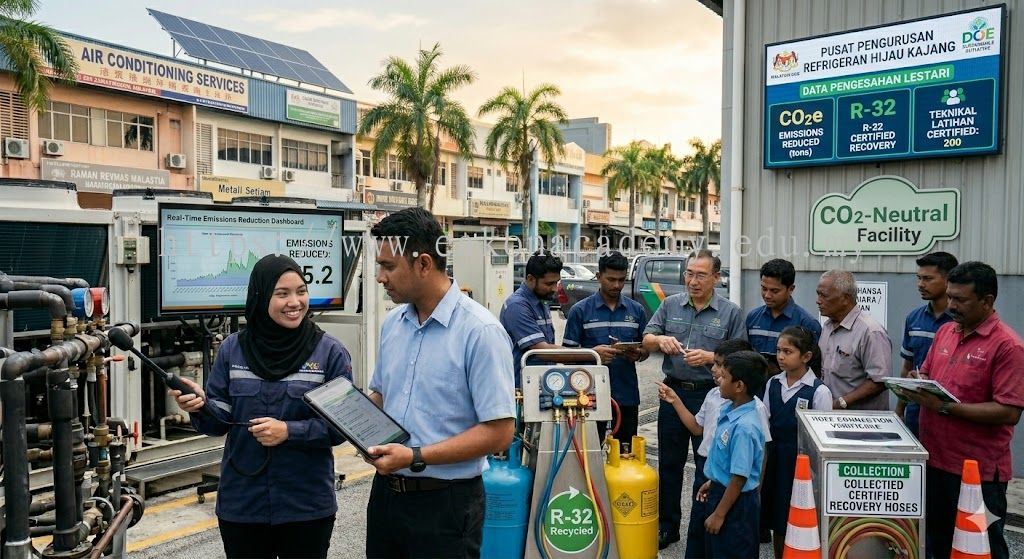
Refrigerant recovery and recycling technologies are another important aspect of green refrigerant management. During maintenance, servicing, or system decommissioning, refrigerants must be safely recovered using certified green technology equipment instead of being released into the atmosphere. Recovered refrigerants can be recycled, reclaimed, or reused, supporting circular economy principles and reducing environmental pollution. These practices help conserve resources and promote sustainable refrigerant lifecycle management.
Technician training and competency are essential for implementing green technology refrigerant management Malaysia effectively. HVACR professionals must be trained in advanced system diagnostics, green technology applications, refrigerant handling, leak detection methods, and environmental compliance standards. Continuous training ensures technicians stay updated on emerging technologies, DOE guidelines, and global sustainability trends. Skilled technicians are essential for ensuring the successful implementation of green HVACR solutions.
Accurate documentation and digital refrigerant tracking systems also play a vital role in green technology refrigerant management. Organizations must maintain detailed records of refrigerant usage, leak detection results, recovery operations, maintenance activities, and system performance. Digital tracking systems improve transparency, enhance regulatory compliance, and support data-driven decision-making for sustainability improvements.
At eakonacadem.edu.my, HVACR technicians, engineers, facility managers, and industry professionals can access specialized training programs focused on green technology refrigerant management Malaysia, refrigerant handling, leak prevention, HVACR system maintenance, environmental compliance, and sustainable refrigeration technologies. These programs combine theoretical instruction with practical hands-on training, equipping participants with the skills required to implement advanced green HVACR solutions.
As Malaysia continues to expand its green technology initiatives and environmental commitments, green technology refrigerant management Malaysia will remain a key driver of sustainable HVACR development. Organizations that adopt these practices can reduce environmental impact, improve energy efficiency, lower operational costs, enhance regulatory compliance, and support national and global climate goals. Through professional education and industry-focused training provided by eakonacadem.edu.my, HVACR professionals can develop the expertise needed to lead green technology adoption and contribute to a cleaner, more efficient, and environmentally sustainable future.
Lihat detail lebih lanjut tentang EAKON ACADEMY SDN BHD Malaysia
