
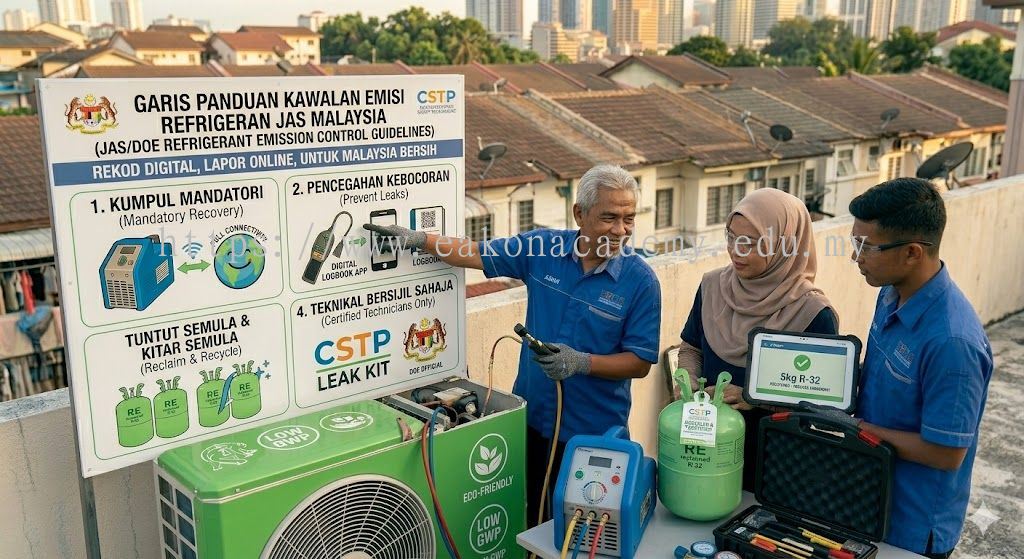
SUSTAINABLE REFRIGERANT EMISSION CONTROL MALAYSIA
Sustainable refrigerant emission control in Malaysia is a critical environmental initiative under the Department of Environment (DOE) aimed at reducing greenhouse gas emissions and promoting long-term sustainability within the HVACR (Heating, Ventilation, Air Conditioning, and Refrigeration) industry. Refrigerants used in cooling and refrigeration systems, particularly hydrofluorocarbons (HFCs) and hydrochlorofluorocarbons (HCFCs), are known for their high global warming potential (GWP). When these gases are released into the atmosphere due to leaks, improper handling, or poor maintenance practices, they contribute significantly to climate change. As a result, sustainable refrigerant emission control Malaysia has become a key focus for regulatory authorities, industries, and training institutions working together to create a greener and more responsible HVACR sector.
The concept of sustainable emission control goes beyond basic compliance. It involves implementing long-term strategies that reduce refrigerant leakage, improve system efficiency, and encourage the use of environmentally friendly technologies. This includes proper system design, high-quality installation practices, regular maintenance schedules, and the use of advanced leak detection tools. Technicians must ensure that all refrigerant handling activities are performed using certified recovery equipment and approved procedures to prevent unnecessary emissions. Preventive maintenance plays a crucial role in identifying early signs of leakage and system inefficiencies, helping to minimize environmental impact while optimizing energy consumption.
In Malaysia, sustainable refrigerant emission control is closely aligned with international environmental commitments such as the Montreal Protocol and Kigali Amendment. These agreements aim to phase down high-GWP refrigerants and promote the adoption of low-GWP and natural refrigerants. As a result, the HVACR industry is gradually transitioning toward environmentally friendly alternatives such as R32, R290 (propane), and carbon dioxide (CO ) systems. These refrigerants offer significantly lower environmental impact while maintaining high cooling performance and energy efficiency, making them essential for sustainable development in the cooling sector.
Training and professional development are essential components of achieving sustainable refrigerant emission control Malaysia standards. Skilled HVACR technicians are required to understand refrigerant lifecycle management, leak prevention techniques, recovery procedures, and environmental compliance requirements. Institutions such as Eakon Academy (eakonacadem.edu.my) play an important role in providing structured HVACR training programs that align with DOE regulations and industry best practices. These programs equip learners with both theoretical knowledge and hands-on experience, enabling them to implement sustainable practices effectively in real-world HVACR applications.
Another important aspect of sustainability in refrigerant emission control is proper documentation and lifecycle tracking. Facilities and service providers are required to maintain detailed records of refrigerant usage, leakage incidents, recovery quantities, and disposal methods. This ensures transparency, supports regulatory compliance, and helps organizations identify areas for improvement. Proper documentation also encourages businesses to adopt more efficient operational strategies and reduce overall environmental impact.
In conclusion, sustainable refrigerant emission control Malaysia is a vital approach for reducing environmental harm, improving energy efficiency, and ensuring compliance with DOE regulations. By adopting best practices, using advanced technologies, transitioning to low-GWP refrigerants, and investing in professional training through institutions like Eakon Academy (eakonacadem.edu.my), the HVACR industry in Malaysia can significantly reduce its carbon footprint. These collective efforts support national sustainability goals and contribute to building a cleaner, greener, and more environmentally responsible future.
Lihat detail lebih lanjut tentang EAKON ACADEMY SDN BHD Malaysia
