
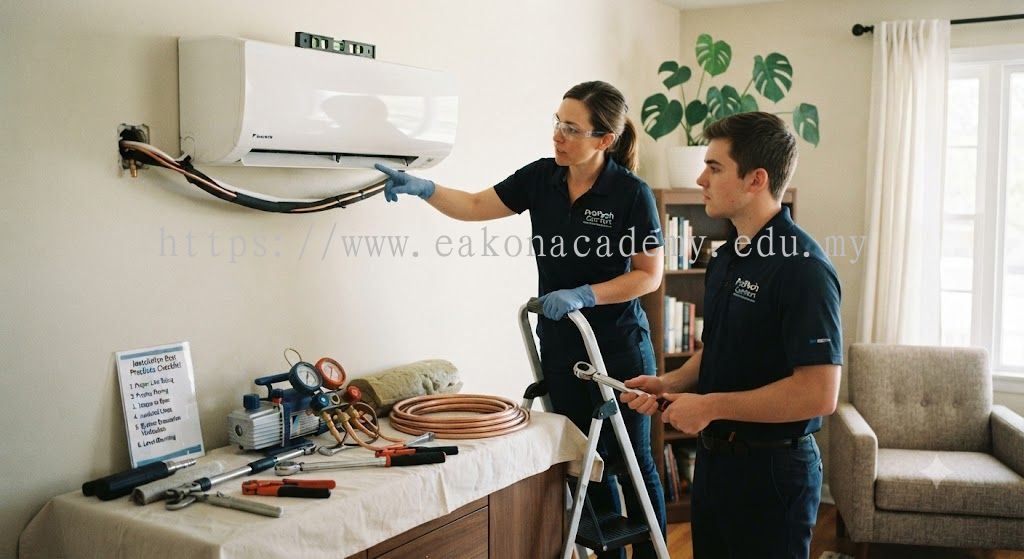
Air Conditioning Installation Technician Best Practices for Professional HVAC Skills and Industry Excellence
Air conditioning installation technician best practices are essential for developing skilled HVAC professionals who can perform safe, efficient, and reliable air conditioning installation work. A qualified air conditioning technician requires a combination of technical knowledge, practical experience, safety awareness, and proper installation techniques to ensure cooling systems operate at their highest performance. Professional installation directly affects energy efficiency, system reliability, maintenance requirements, and equipment lifespan. Eakon Academy provides comprehensive HVAC training programs designed to help learners develop the knowledge and practical abilities required to become competent air conditioning installation technicians.
A professional air conditioning installation technician must understand the complete installation process, from site assessment and equipment preparation to refrigerant system testing and final commissioning. Following industry best practices allows technicians to reduce installation errors, improve system efficiency, and provide better service quality. Proper HVAC training helps participants understand modern air conditioning technologies, installation procedures, and professional standards required in residential, commercial, and industrial environments.
One of the most important air conditioning installation technician best practices is conducting proper site evaluation before installation begins. Technicians should assess room conditions, cooling requirements, equipment specifications, installation locations, and accessibility for future maintenance. Accurate planning helps ensure the selected air conditioning system performs effectively and provides comfortable cooling. Professional technicians understand that every installation project requires careful evaluation to achieve the best results.
Correct handling and installation of refrigerant piping is another essential skill for air conditioning installation technicians. Professionals must know how to properly measure, cut, bend, flare, braze, insulate, and connect copper piping according to system requirements. Poor piping installation can result in refrigerant leaks, reduced cooling performance, and increased energy consumption. HVAC training provides hands-on experience in refrigerant piping techniques, leak testing procedures, vacuum processes, and system preparation methods.
Electrical installation knowledge is also a key requirement for professional air conditioning technicians. Technicians must understand wiring connections, power requirements, circuit protection, grounding methods, and electrical safety procedures. Proper electrical installation ensures stable system operation and protects both equipment and users from potential hazards. Following electrical installation best practices improves system reliability and reduces the risk of future failures.
Another important practice for air conditioning installation technicians is ensuring correct mounting and positioning of indoor and outdoor units. Units must be installed securely with proper support, alignment, and ventilation clearance. Correct positioning improves airflow performance, reduces vibration, and allows easier servicing. Professional technicians must understand how installation location affects system efficiency and overall customer comfort.
System testing and commissioning are also important responsibilities of an air conditioning installation technician. After installation, technicians should verify refrigerant pressure, temperature performance, airflow conditions, electrical readings, and overall system operation. Proper testing ensures that the air conditioner functions according to manufacturer specifications and identifies possible issues before handover to customers.
Safety awareness is a fundamental part of air conditioning installation technician best practices. Technicians must follow workplace safety procedures, use appropriate protective equipment, handle tools correctly, and apply safe working methods when dealing with electrical systems and refrigerants. Professional training helps technicians develop responsible work habits and maintain high installation standards.
Continuous learning is important because air conditioning technology continues to evolve with new energy-efficient systems, advanced controls, and environmentally friendly refrigerants. Skilled technicians who update their knowledge can provide better installation services and remain competitive in the HVAC industry.
Eakon Academy offers HVAC training courses that focus on practical installation techniques, troubleshooting skills, and professional industry requirements. By learning air conditioning installation technician best practices, participants can strengthen their technical capabilities, improve workplace confidence, and prepare for successful careers in HVAC installation, servicing, and maintenance. Professional training helps develop qualified technicians who can deliver safe, efficient, and reliable air conditioning solutions for modern cooling applications.
More detail about EAKON ACADEMY SDN BHD Malaysia
