
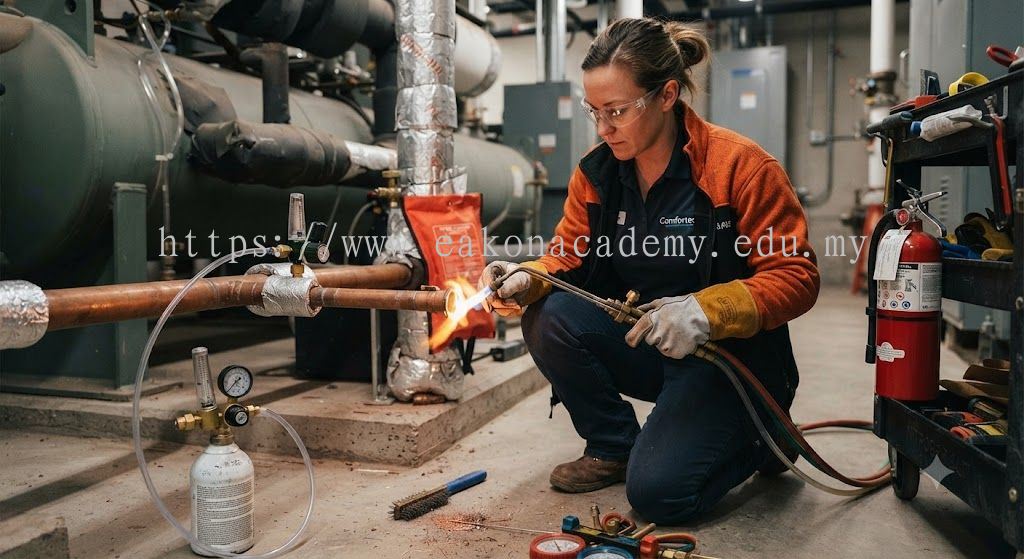
REFRIGERATION SAFE BRAZING HVAC FIELD PRACTICES | PROFESSIONAL ON-SITE COPPER PIPE INSTALLATION & TRAINING
Refrigeration safe brazing HVAC field practices are essential professional procedures used by technicians to ensure safe, efficient, and high-quality copper pipe installations in real-world refrigeration and air-conditioning environments. Unlike controlled workshop settings, field brazing is performed on actual job sites such as residential buildings, commercial facilities, and industrial HVAC systems, where environmental conditions, safety risks, and installation challenges can vary significantly. Because brazing involves high-temperature flames, pressurized refrigerant systems, and combustible materials, following strict safe field practices is crucial to prevent accidents, ensure system reliability, and maintain industry compliance. At eakonacadem.edu.my, we focus on equipping HVAC technicians with practical field skills and safety knowledge required for real-world installations.
A key element of refrigeration safe brazing HVAC field practices is proper site assessment and preparation. Before beginning any brazing work, technicians must inspect the job site to identify potential hazards such as flammable materials, electrical wiring, confined spaces, poor ventilation, or nearby equipment that may be affected by heat. Clearing the workspace and creating a controlled working environment is essential for reducing fire risks and ensuring safe brazing operations in the field. Proper planning also helps technicians position tools and materials efficiently for smooth workflow execution.
Another critical practice is equipment setup and gas cylinder safety. Oxygen and acetylene cylinders used in field brazing must be securely placed in an upright position and protected from direct sunlight, heat sources, or physical damage. Technicians must carefully inspect regulators, hoses, torch connections, and valves for leaks or wear before ignition. Safe handling of pressurized gases is extremely important in field conditions, where environmental factors may increase the risk of accidents if proper procedures are not followed.
Personal Protective Equipment (PPE) is a mandatory requirement in refrigeration safe brazing HVAC field practices. Technicians must wear safety goggles or welding shields, heat-resistant gloves, flame-resistant clothing, long trousers, and safety boots when working on-site. PPE protects against sparks, radiant heat, molten filler metal, and accidental flame exposure. In field environments, where unexpected hazards may be present, proper PPE usage is essential for ensuring technician safety and compliance with HVAC industry standards.
Flame control and torch handling techniques are also vital in field brazing operations. Technicians must be able to properly adjust oxygen and fuel gas mixtures to produce a neutral flame suitable for copper pipe brazing. In outdoor or uncontrolled environments, wind and temperature conditions can affect flame stability, making proper torch handling even more important. Safe techniques include maintaining correct flame distance, steady movement, and consistent heat application to ensure strong and reliable brazed joints.
Nitrogen purging is another essential component of refrigeration safe brazing HVAC field practices. During field brazing, a controlled flow of dry nitrogen is introduced into the piping system to prevent internal oxidation, commonly known as black scale formation. Without nitrogen purging, internal contamination can damage compressors, expansion valves, and filter driers, leading to reduced system efficiency and costly repairs. Proper nitrogen flow control ensures clean internal piping and enhances long-term refrigeration system performance.
Post-brazing inspection and leak testing are also critical field practices. After completing brazing work, technicians must visually inspect all joints for proper filler flow, smooth coverage, and absence of cracks or defects. Pressure testing using nitrogen followed by leak detection ensures that the system is fully sealed and safe for refrigerant charging. These steps are essential in field installations to verify system integrity and prevent future operational failures.
Fire safety and emergency preparedness are equally important in HVAC field brazing practices. Technicians must always have fire extinguishers available and be trained to respond quickly to gas leaks, fire outbreaks, or unexpected equipment malfunctions. Awareness of surrounding site conditions and adherence to hot work safety protocols significantly reduce risks in outdoor and industrial environments.
At eakonacadem.edu.my, our HVAC training programs are designed to prepare technicians for real-world field conditions through hands-on practical experience and structured safety training. Students are trained in copper pipe brazing techniques, nitrogen purging, flame control, PPE usage, leak testing, pressure testing, fire safety procedures, and full refrigeration installation practices in both workshop and field environments. This ensures that every trainee is fully prepared for professional HVAC work.
Refrigeration safe brazing HVAC field practices are essential for ensuring safe installations, system efficiency, and long-term reliability in real job environments. By mastering proper field techniques and safety procedures, HVAC technicians can reduce risks, improve workmanship quality, and build successful careers in the refrigeration and air-conditioning industry.
More detail about EAKON ACADEMY SDN BHD Malaysia
