
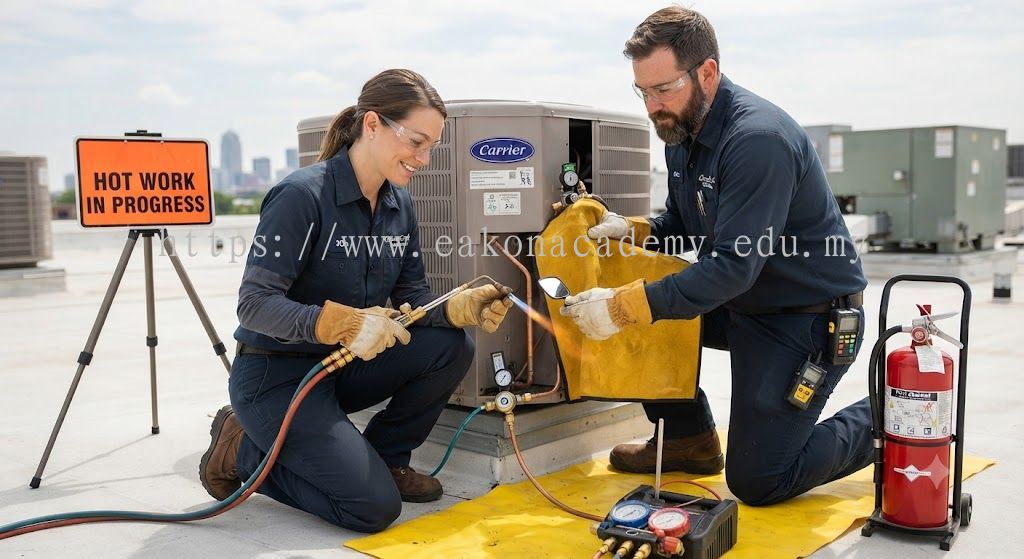
REFRIGERATION HVAC SAFE BRAZING TECHNIQUES | PROFESSIONAL COPPER PIPE JOINING & INDUSTRY SKILLS TRAINING
Refrigeration HVAC safe brazing techniques are essential professional methods used to ensure strong, leak-free, and durable copper pipe connections in refrigeration and air-conditioning systems. In HVAC-R applications, brazing is a critical process that joins copper tubing using high-temperature heat and filler metals, creating permanent joints capable of withstanding high pressure and temperature variations. Because this process involves open flames, pressurized gases, and molten materials, proper safe brazing techniques are required to prevent accidents, improve system reliability, and ensure long-term performance. At eakonacadem.edu.my, we focus on providing industry-relevant HVAC training that emphasizes both technical precision and strict safety standards.
A key aspect of refrigeration HVAC safe brazing techniques is proper copper pipe preparation. Before any brazing work begins, technicians must ensure that all copper tubing is accurately measured, cut, deburred, cleaned, and properly aligned. Clean and well-fitted pipe joints are essential for achieving strong capillary action, which allows brazing filler material to flow evenly between surfaces. Any contamination such as oil, dust, moisture, or oxidation can weaken the joint and lead to system failure. Proper preparation is the foundation of safe and effective brazing practices.
Another important technique in HVAC brazing safety is controlled flame adjustment and torch handling. Technicians must learn how to properly operate oxy-acetylene or air-acetylene torches, ensuring the correct oxygen and fuel mixture to produce a neutral flame. A neutral flame provides stable heat without causing excessive oxidation or damage to copper tubing. Safe torch handling includes maintaining the correct flame distance, consistent movement, and controlled heating patterns to ensure even heat distribution around the joint area.
Nitrogen purging is one of the most critical refrigeration HVAC safe brazing techniques used in modern installation practices. During brazing, a controlled flow of dry nitrogen is introduced into the copper piping system to prevent internal oxidation, commonly known as black scale formation. Without nitrogen purging, internal contamination can damage compressors, expansion valves, and filter driers, leading to reduced system efficiency and costly repairs. Proper nitrogen flow control ensures clean internal piping and improves long-term refrigeration system reliability.
Heat control is another essential technique in HVAC safe brazing. Technicians must learn how to apply heat evenly across the joint instead of concentrating it in one area. Overheating can weaken copper tubing, damage insulation, and compromise nearby components. Proper heat control ensures that the brazing filler rod melts due to joint temperature rather than direct flame contact, resulting in strong and uniform bonding. Mastering heat control is essential for producing professional-quality brazed joints in refrigeration systems.
Personal Protective Equipment (PPE) usage is also an important part of refrigeration HVAC safe brazing techniques. Technicians must wear safety goggles or welding shields, heat-resistant gloves, flame-resistant clothing, and safety boots to protect against burns, sparks, and molten metal exposure. Proper PPE ensures technician safety and compliance with workplace safety regulations in HVAC environments.
Post-brazing inspection and leak testing are also included in safe brazing techniques. After completing the brazing process, technicians must visually inspect all joints for proper filler flow, smooth coverage, and absence of cracks or defects. Pressure testing using nitrogen followed by leak detection ensures that the system is fully sealed and ready for refrigerant charging. These steps are essential for maintaining HVAC system performance and preventing future operational issues.
Fire safety awareness and emergency preparedness are also critical components of refrigeration HVAC safe brazing techniques. Technicians must always have access to fire extinguishers and be trained in handling gas leaks, fire outbreaks, or equipment malfunctions. Maintaining awareness of surrounding hazards and following proper hot work procedures significantly reduces workplace risks.
At eakonacadem.edu.my, our HVAC training programs are designed to provide both theoretical knowledge and practical hands-on experience. Students are trained in copper pipe brazing techniques, nitrogen purging methods, flame control, PPE usage, leak testing, pressure testing, fire safety procedures, and complete refrigeration installation practices. This ensures that every trainee is fully prepared for real-world HVAC industry requirements.
Refrigeration HVAC safe brazing techniques are essential for ensuring system reliability, technician safety, and long-term performance. By mastering proper techniques, HVAC professionals can deliver high-quality installations, reduce system failures, and build successful careers in the refrigeration and air-conditioning industry.
More detail about EAKON ACADEMY SDN BHD Malaysia
