
Copper Pipe Brazing Split Air Conditioner HVAC Installation and Techniques
Copper pipe brazing for split air conditioner HVAC systems is one of the most important technical processes in modern air-conditioning installation and maintenance. This essential skill ensures that copper refrigerant lines are securely joined, leak-free, and capable of handling high-pressure refrigerant flow in split AC systems. Proper brazing directly impacts system efficiency, cooling performance, and long-term reliability, making it a core competency for HVAC technicians and engineers working in residential, commercial, and industrial applications.
The foundation of copper pipe brazing in split air conditioner HVAC systems begins with accurate pipe preparation. Technicians must carefully measure, cut, and deburr copper pipes to ensure a precise and clean joint fit. Any irregular edges, dirt, oil, or oxidation must be removed before brazing begins, as contaminants can weaken the bond between copper surfaces. Proper preparation ensures that the brazing filler material flows smoothly into the joint, creating a strong and durable connection that can withstand system pressure and vibration during operation.
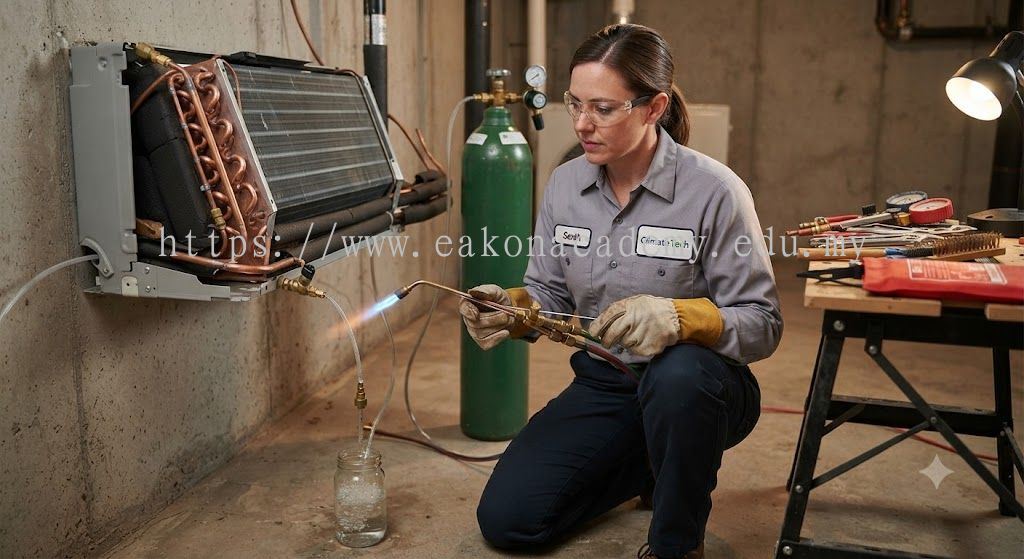
Another critical aspect of copper pipe brazing for split air conditioner HVAC systems is controlled heat application using a brazing torch. The technician must apply heat evenly around the joint to reach the correct brazing temperature without overheating the copper material. When the correct temperature is achieved, the filler rod is introduced, and it flows into the joint through capillary action, forming a sealed and high-strength connection. Incorrect heating techniques can lead to weak joints, leaks, or damage to the copper tubing, which may compromise the entire refrigeration system.
A highly important advanced practice in copper pipe brazing is the use of nitrogen purging during the process. By introducing a controlled, low-pressure flow of nitrogen gas into the piping system, oxygen is displaced from inside the copper pipes. This prevents oxidation caused by high heat exposure, which would otherwise form black scale deposits inside the tubing. These deposits can circulate through the system and damage critical components such as compressors, expansion valves, and filters. Nitrogen purging ensures that the internal piping remains clean, improving system efficiency and extending equipment lifespan.
The selection of appropriate brazing filler materials is also essential in split air conditioner HVAC installation. Depending on system requirements, technicians may use silver-based brazing rods or other approved alloys designed for HVAC applications. These materials provide strong bonding, corrosion resistance, and durability under varying temperature and pressure conditions. Choosing the correct filler ensures long-lasting joint integrity and reliable system operation.
Post-brazing inspection and testing are also important steps in ensuring system performance. After completing the brazing process, technicians must carefully inspect all joints for uniformity, proper penetration, and any signs of defects. A nitrogen pressure test is typically conducted to confirm system integrity and detect potential leaks before refrigerant charging. These quality control procedures are essential for ensuring safe and efficient HVAC system operation.
Training institutions such as Eakon Academy emphasize copper pipe brazing for split air conditioner HVAC systems as a core skill in their professional training programs. Through hands-on practical learning, students are trained in pipe preparation, torch control, nitrogen purging, and proper installation techniques. This real-world training approach ensures that graduates are fully prepared to meet industry standards and perform high-quality HVAC installations with confidence.
In addition, mastering copper pipe brazing techniques improves overall system efficiency, reduces energy consumption, and minimizes maintenance issues. Properly brazed joints prevent refrigerant leakage, maintain stable system pressure, and enhance cooling performance. This results in longer system lifespan, improved reliability, and greater customer satisfaction in both residential and commercial applications.
In conclusion, copper pipe brazing for split air conditioner HVAC systems is a vital technical skill that ensures strong joints, clean internal piping, and efficient system performance. It combines precise preparation, controlled heating, nitrogen purging, and professional workmanship to achieve industry-standard installation quality. For HVAC technicians and trainees, mastering this technique is essential for building a successful career in air-conditioning installation and maintenance.
More detail about EAKON ACADEMY SDN BHD Malaysia
