
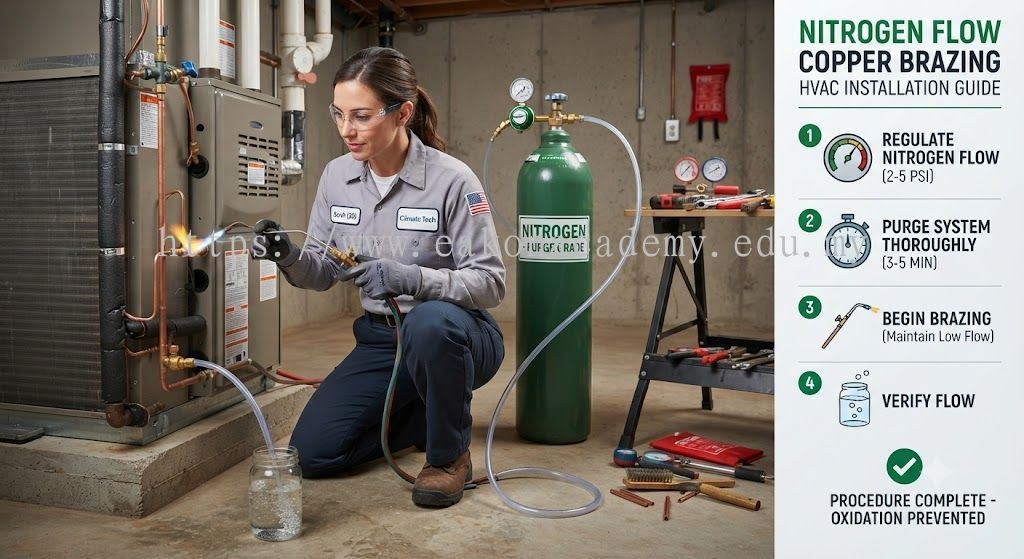
Nitrogen Flow Copper Brazing HVAC Installation Guide
Eakon Academy is a recognized provider of professional HVAC-R education, offering industry-focused training programs that equip technicians with the practical skills required for successful careers in refrigeration and air conditioning. One of the most valuable technical resources for both students and experienced professionals is the Nitrogen Flow Copper Brazing HVAC Installation Guide, which explains the proper procedures for using nitrogen during copper pipe brazing to produce clean, durable, and leak-free refrigeration systems. Nitrogen purging has become a standard practice in modern HVAC installations because it prevents internal oxidation, protects refrigeration components, improves brazed joint quality, and enhances the overall efficiency and reliability of air conditioning and refrigeration systems.
The Nitrogen Flow Copper Brazing HVAC Installation Guide begins with understanding the role of copper tubing within HVAC-R systems. Copper pipes are widely used because of their excellent heat transfer properties, corrosion resistance, and long service life. They transport refrigerant between major system components such as compressors, condensers, evaporators, filter driers, and expansion valves. Since every refrigerant circuit depends on properly sealed copper joints, the quality of each brazed connection directly affects cooling performance, energy efficiency, refrigerant containment, and equipment durability. Using nitrogen during the brazing process ensures that these joints are manufactured according to professional installation standards.
Proper preparation is the first stage of the Nitrogen Flow Copper Brazing HVAC Installation Guide. Before brazing begins, technicians should accurately measure, cut, and deburr the copper tubing to eliminate sharp edges and metal fragments. The inside of fittings and the outside of copper pipes must be cleaned thoroughly to remove dirt, oxidation, oil, moisture, and contaminants that could interfere with the brazing process. Correct joint clearance allows the brazing alloy to flow smoothly by capillary action, creating strong metallurgical bonds that resist vibration, pressure, and thermal expansion throughout the system's service life.
One of the most important sections of the Nitrogen Flow Copper Brazing HVAC Installation Guide focuses on nitrogen equipment setup. Dry nitrogen cylinders should always be secured in an upright position and connected to an approved pressure regulator and flow control device. Before use, technicians should inspect hoses, fittings, regulators, and cylinder connections to ensure there are no leaks or damaged components. Nitrogen is introduced into one end of the refrigeration piping while the opposite end remains open to allow continuous gas movement through the copper tubing. This gentle flow removes oxygen from the piping before heat is applied, preventing internal oxidation during brazing.
Maintaining proper nitrogen flow is essential throughout the HVAC installation process. The Nitrogen Flow Copper Brazing HVAC Installation Guide recommends using a low, continuous nitrogen purge rather than high-pressure flow. The objective is to displace oxygen without creating turbulence inside the copper tubing. Excessive nitrogen flow may interfere with filler alloy distribution or cool the joint too quickly, while insufficient flow may allow copper oxide scale to form inside the pipe. Correct nitrogen regulation ensures clean internal pipe surfaces, stronger brazed joints, and improved refrigeration system reliability.
Heat control is another important topic covered in the Nitrogen Flow Copper Brazing HVAC Installation Guide. Technicians should use a properly adjusted neutral flame and apply heat evenly around the copper fitting rather than directly heating the brazing alloy. Uniform heating allows the copper to reach the proper brazing temperature while preventing overheating and material damage. Once the joint reaches the correct temperature, the silver brazing alloy should melt naturally through the heat of the copper and flow completely around the connection by capillary action. Nitrogen should continue flowing during both heating and cooling to protect the inside of the tubing until the joint has fully solidified.
Inspection and quality assurance are essential final stages of the Nitrogen Flow Copper Brazing HVAC Installation Guide. After the joints have cooled naturally, technicians should inspect each connection for smooth filler distribution, complete penetration, and consistent appearance. Pressure testing using dry nitrogen confirms the strength and integrity of the refrigeration piping, while leak testing verifies that every brazed joint is completely sealed before refrigerant charging. These quality control procedures improve installation reliability, reduce maintenance costs, and ensure compliance with professional HVAC-R standards.
Safety is also emphasized throughout the Nitrogen Flow Copper Brazing HVAC Installation Guide. Technicians should always wear appropriate personal protective equipment, including safety glasses, heat-resistant gloves, flame-resistant clothing, and protective footwear. Proper ventilation should be maintained during brazing operations, and nitrogen cylinders should always be handled, stored, and transported according to established safety procedures. Following these practices helps create a safe working environment while protecting both technicians and refrigeration equipment.
At Eakon Academy, students receive extensive practical instruction based on the principles outlined in the Nitrogen Flow Copper Brazing HVAC Installation Guide. The hands-on training covers copper pipe preparation, nitrogen purging methods, pressure regulator adjustment, torch handling, silver brazing techniques, pressure testing, leak detection, refrigeration system commissioning, and workplace safety. This comprehensive approach prepares graduates to meet the technical expectations of employers across residential, commercial, and industrial HVAC-R sectors.
In conclusion, following a Nitrogen Flow Copper Brazing HVAC Installation Guide is essential for producing clean, efficient, and long-lasting refrigeration systems. Proper nitrogen purging prevents internal oxidation, protects compressors and other critical system components, improves refrigerant circulation, enhances energy efficiency, and extends equipment lifespan. Combined with accurate copper preparation, controlled heat application, detailed inspection, and professional instruction from Eakon Academy, technicians can consistently deliver leak-free, high-quality HVAC installations that meet modern industry standards and provide exceptional long-term performance.
More detail about EAKON ACADEMY SDN BHD Malaysia
