
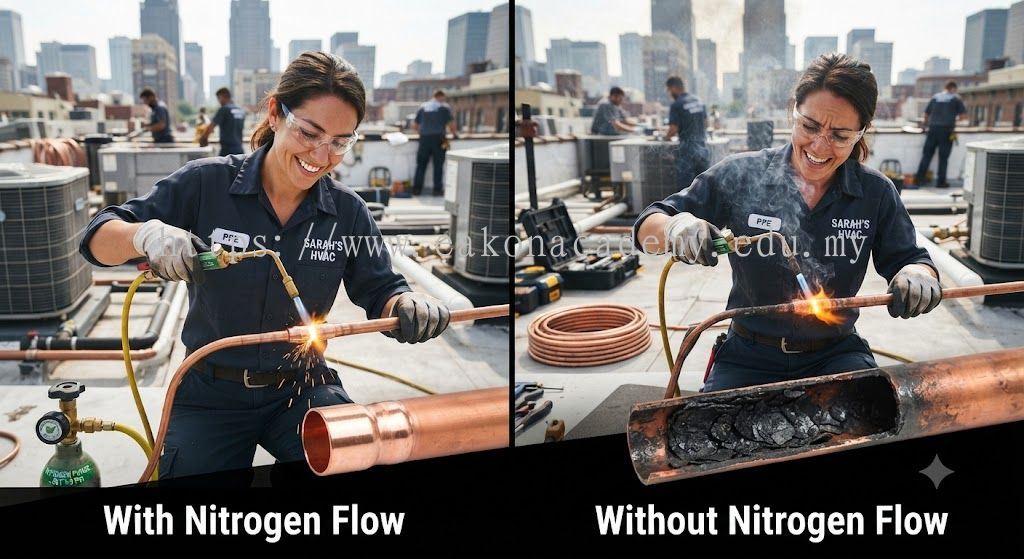
Importance of Nitrogen Flow During Brazing HVAC
Eakon Academy is committed to delivering high-quality HVAC-R education that equips technicians with the practical skills and technical knowledge required by today's refrigeration and air conditioning industry. One of the most essential concepts taught in professional refrigeration training is the importance of nitrogen flow during brazing HVAC. Nitrogen purging has become an industry best practice because it protects the internal condition of copper piping during brazing, prevents oxidation, improves joint quality, and significantly increases the reliability of refrigeration systems. Whether working on residential air conditioners, commercial refrigeration equipment, supermarket cooling systems, or industrial HVAC installations, understanding the importance of nitrogen flow during brazing is fundamental for producing professional-quality work that meets modern HVAC-R standards.
The importance of nitrogen flow during brazing HVAC begins with preventing internal oxidation. During the brazing process, copper tubing is heated to high temperatures using an oxy-fuel torch. If oxygen remains inside the tubing while heat is applied, it reacts with the heated copper surface and forms copper oxide scale, commonly recognized as black flakes inside the pipe. These oxidation particles may appear harmless initially, but once the refrigeration system is commissioned, they can circulate with the refrigerant and compressor oil throughout the entire system. Over time, these contaminants may clog expansion valves, block capillary tubes, restrict refrigerant flow, damage compressors, and reduce the overall performance of the HVAC system. A continuous flow of dry nitrogen eliminates oxygen from inside the copper tubing, preventing oxidation from forming and maintaining a clean refrigeration circuit.
Another important reason for using nitrogen during brazing is to improve the quality of copper pipe joints. Clean internal pipe surfaces allow the brazing alloy to create stronger metallurgical bonds between the copper tube and fitting. When oxidation is prevented, the completed joint is more reliable, more durable, and less likely to develop refrigerant leaks over time. Leak-free brazed joints are essential because refrigerant leakage reduces cooling capacity, increases operating costs, harms system efficiency, and may result in expensive service repairs. By understanding the importance of nitrogen flow during brazing HVAC, technicians can consistently produce stronger and longer-lasting copper connections.
The importance of nitrogen flow during brazing HVAC also extends to protecting expensive refrigeration components. Modern HVAC-R systems contain precision components such as electronic expansion valves, thermostatic expansion valves, filter driers, compressors, oil separators, and pressure control devices. These components are designed to operate with clean refrigerant and uncontaminated compressor oil. Copper oxide particles generated during poor brazing practices can circulate throughout the system and cause premature wear, mechanical blockage, or reduced lubrication. Using nitrogen during brazing helps preserve the cleanliness of the refrigeration circuit, protecting valuable equipment and extending the operational lifespan of the entire system.
Energy efficiency is another significant benefit that highlights the importance of nitrogen flow during brazing HVAC. Clean refrigeration piping allows refrigerant to circulate freely without restrictions caused by oxidation debris. Proper refrigerant flow enables compressors, condensers, evaporators, and expansion devices to operate at their intended performance levels, resulting in improved cooling capacity and reduced electrical energy consumption. Systems installed using proper nitrogen purging techniques generally require less maintenance, operate more efficiently, and provide more consistent temperature control throughout their service life.
Professional workmanship is closely connected to the importance of nitrogen flow during brazing HVAC. Today, many manufacturers, engineering consultants, contractors, and facility owners expect technicians to follow industry best practices that include nitrogen purging during all copper brazing operations. Proper nitrogen use demonstrates technical competence, attention to detail, and commitment to quality installation standards. Technicians who consistently apply nitrogen purging techniques often build stronger professional reputations, reduce warranty claims, and increase customer satisfaction by delivering reliable refrigeration systems with fewer service issues.
Learning the correct nitrogen purging procedure is an essential part of professional HVAC education. At Eakon Academy, students receive comprehensive hands-on training that explains the importance of nitrogen flow during brazing HVAC while developing practical skills in copper pipe preparation, nitrogen cylinder handling, pressure regulator adjustment, torch operation, silver brazing techniques, leak testing, pressure testing, and refrigeration system commissioning. The training combines classroom theory with realistic workshop exercises to ensure graduates understand both the technical principles and practical applications of nitrogen purging in modern HVAC-R installations.
Safety is another important consideration when discussing the importance of nitrogen flow during brazing HVAC. Students are trained to use nitrogen cylinders safely, inspect regulators and hoses before use, maintain proper ventilation during brazing, and follow established fire prevention procedures. Understanding safe nitrogen handling protects technicians, equipment, and customer property while ensuring professional working practices in residential, commercial, and industrial environments.
In conclusion, understanding the importance of nitrogen flow during brazing HVAC is essential for every refrigeration and air conditioning technician. Nitrogen purging prevents internal oxidation, improves brazed joint quality, protects expensive refrigeration components, increases system efficiency, reduces maintenance costs, and extends equipment lifespan. Combined with proper copper pipe preparation, accurate torch control, comprehensive inspection, and professional training from Eakon Academy, mastering nitrogen flow techniques enables technicians to produce clean, reliable, leak-free refrigeration systems that meet modern HVAC-R industry standards while delivering exceptional long-term performance and customer satisfaction.
More detail about EAKON ACADEMY SDN BHD Malaysia
