
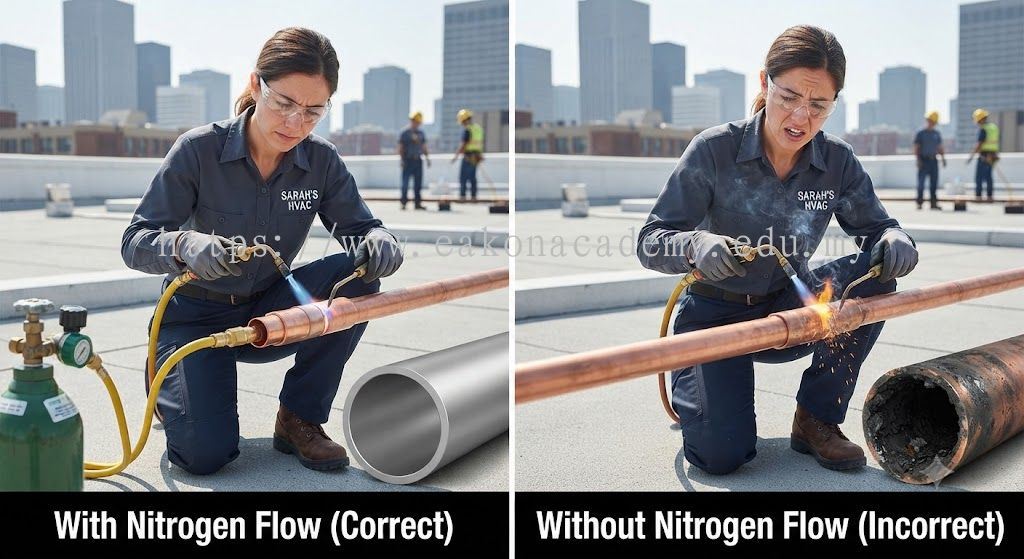
HVAC Refrigeration Nitrogen Flow Brazing Process
Eakon Academy is a leading HVAC-R training institution committed to developing highly skilled refrigeration and air conditioning technicians through comprehensive, hands-on education that reflects current industry standards. One of the most essential technical competencies taught in professional refrigeration training is the HVAC refrigeration nitrogen flow brazing process, a critical procedure used to produce clean, durable, and leak-free copper pipe joints while preventing internal oxidation during installation and maintenance. As modern refrigeration systems become increasingly sophisticated and energy efficient, mastering the correct nitrogen flow brazing process is vital for technicians who want to deliver reliable system performance, extend equipment lifespan, and comply with professional HVAC-R installation standards.
The HVAC refrigeration nitrogen flow brazing process begins with careful planning and preparation of the refrigeration piping. Copper tubing should be accurately measured, cut, and deburred to eliminate sharp edges that could interfere with refrigerant flow. The outside of the tube and the inside of the fitting must be thoroughly cleaned using suitable abrasive materials to remove oxidation, oil, dirt, moisture, and other contaminants. Clean copper surfaces promote excellent capillary action and allow the brazing alloy to bond effectively with the base metal. Proper preparation significantly improves joint strength and reduces the likelihood of refrigerant leaks after system commissioning.
One of the most important stages of the HVAC refrigeration nitrogen flow brazing process is the setup of the nitrogen purging system. A dry nitrogen cylinder should be secured in an upright position and connected to a pressure regulator and flow control device. Before brazing begins, technicians should inspect the regulator, hoses, and fittings to ensure there are no leaks or damaged components. Nitrogen is introduced into one end of the refrigeration piping while the opposite end remains open, allowing a continuous, gentle flow through the copper tubing. This low-pressure purge removes oxygen from the interior of the pipe and protects the system throughout the brazing operation.
Understanding the purpose of nitrogen flow is fundamental to the HVAC refrigeration nitrogen flow brazing process. When copper tubing is heated without nitrogen protection, oxygen inside the pipe reacts with the hot copper surfaces, forming copper oxide scale. These oxidation particles can circulate through the refrigeration system after commissioning, contaminating compressor oil, restricting refrigerant flow, blocking expansion valves, and accelerating wear on critical system components. Continuous nitrogen purging prevents oxidation from developing inside the copper tubing, resulting in a cleaner refrigeration circuit, improved energy efficiency, and greater long-term system reliability.
Heat application is another essential element of the HVAC refrigeration nitrogen flow brazing process. Technicians should use a properly adjusted neutral flame and apply heat evenly around the copper fitting rather than directly heating the brazing alloy. Uniform heating allows the copper to reach the correct brazing temperature while minimizing the risk of overheating, distortion, or weakening of the joint. Once the joint reaches the appropriate temperature, the silver brazing alloy should be applied to the connection, allowing capillary action to draw the molten filler metal completely through the joint. This creates a strong metallurgical bond capable of withstanding refrigeration operating pressures and repeated thermal expansion cycles.
Maintaining continuous nitrogen flow throughout both the heating and cooling stages is a critical part of the HVAC refrigeration nitrogen flow brazing process. Nitrogen should continue flowing until the brazed joint has cooled sufficiently, ensuring oxygen cannot enter the pipe while the copper remains at elevated temperatures. Interrupting nitrogen flow too early may allow oxidation to develop during cooling, reducing the effectiveness of the brazing process. Consistent nitrogen purging helps preserve the cleanliness of the refrigeration system and supports long-term operational efficiency.
Inspection and quality assurance complete the HVAC refrigeration nitrogen flow brazing process. After the copper joints have cooled naturally, technicians should perform a thorough visual inspection to verify uniform filler distribution, complete penetration, and proper joint appearance. Pressure testing using dry nitrogen confirms the integrity of the refrigeration piping, while leak detection procedures ensure every brazed connection is fully sealed before refrigerant charging. These inspection methods improve installation quality, reduce maintenance requirements, and ensure compliance with professional HVAC-R standards.
At Eakon Academy, students receive practical instruction in the HVAC refrigeration nitrogen flow brazing process through structured classroom learning and extensive hands-on workshop training. Participants develop skills in copper pipe preparation, nitrogen cylinder handling, pressure regulator adjustment, torch operation, silver brazing techniques, leak testing, pressure testing, refrigeration system commissioning, and workplace safety. The training is designed to prepare graduates for successful careers in residential, commercial, and industrial HVAC-R industries while meeting employer expectations for technical excellence.
In conclusion, mastering the HVAC refrigeration nitrogen flow brazing process is essential for every refrigeration and air conditioning technician who wants to produce professional-quality installations. Correct nitrogen purging prevents internal oxidation, protects compressors and refrigeration components, improves refrigerant circulation, enhances energy efficiency, and extends equipment service life. Combined with proper copper preparation, controlled heat application, careful inspection, and professional training from Eakon Academy, this process enables technicians to deliver clean, durable, and leak-free refrigeration systems that perform reliably and efficiently for many years.
More detail about EAKON ACADEMY SDN BHD Malaysia
