
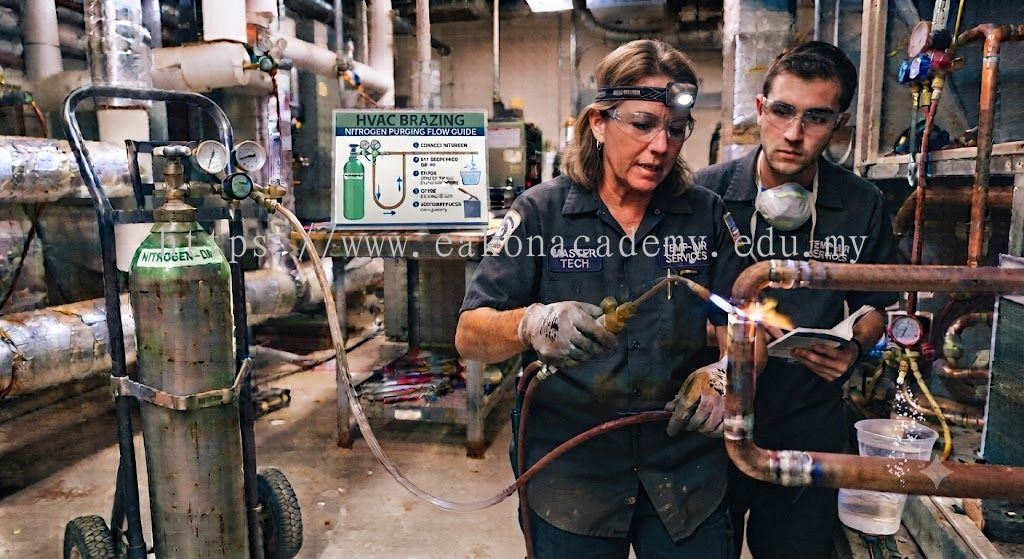
HVAC Copper Pipe Brazing Nitrogen Flow Procedure
Eakon Academy is a trusted HVAC-R training institution dedicated to developing highly competent refrigeration and air conditioning technicians through comprehensive, hands-on technical education. One of the most essential technical skills taught in professional HVAC training is the HVAC copper pipe brazing nitrogen flow procedure, which focuses on the correct method of using nitrogen purging during copper pipe brazing to achieve clean, durable, and leak-free refrigeration systems. Copper tubing is widely used in residential, commercial, and industrial HVAC-R systems because of its excellent thermal conductivity, corrosion resistance, and long service life. However, without proper nitrogen purging during brazing, oxidation can form inside the tubing, reducing system efficiency and increasing the risk of future equipment failure. Understanding and following the correct nitrogen flow procedure is therefore a fundamental requirement for every professional HVAC technician.
The HVAC copper pipe brazing nitrogen flow procedure begins with careful preparation of the copper tubing and the work area. Before any brazing operation starts, technicians should accurately measure, cut, and deburr the copper pipe to ensure smooth and properly aligned joints. All pipe ends and fittings must be cleaned thoroughly to remove oil, dust, moisture, oxidation, and other contaminants that may interfere with brazing quality. A properly prepared joint allows the brazing filler alloy to flow evenly through capillary action, creating a strong and reliable metallurgical bond while reducing the likelihood of refrigerant leaks.
The next stage of the HVAC copper pipe brazing nitrogen flow procedure involves preparing the nitrogen equipment. The nitrogen cylinder should always be secured in an upright position and connected to an approved pressure regulator and flow control device. All hoses, fittings, and regulator connections should be inspected carefully for leaks or signs of damage before use. Proper equipment preparation ensures safe operation and consistent nitrogen delivery throughout the brazing process. Technicians should verify that the regulator is functioning correctly before opening the cylinder valve and adjusting the nitrogen flow.
Once the equipment has been prepared, the nitrogen flow procedure can begin. Nitrogen should be introduced into one end of the refrigeration piping while the opposite end remains open to allow continuous gas flow through the copper tubing. The objective is to gently displace oxygen from the interior of the pipe rather than pressurize the system. Maintaining a continuous, low-pressure nitrogen purge prevents oxygen from reacting with heated copper surfaces, eliminating the formation of copper oxide scale inside the tubing. Clean internal pipe surfaces improve refrigerant circulation, protect compressor lubrication, and reduce the risk of contamination reaching expansion valves and other sensitive components.
Heat application is another important step in the HVAC copper pipe brazing nitrogen flow procedure. While nitrogen continues flowing through the piping, technicians should apply heat evenly around the copper fitting using a properly adjusted neutral flame. Uniform heating allows the copper to reach the appropriate brazing temperature without overheating any single area. Once the joint reaches the correct temperature, the brazing filler alloy should be applied so that it melts through the heat of the copper rather than direct flame contact. Capillary action will draw the filler metal throughout the joint, creating a complete and durable seal capable of withstanding refrigeration operating pressures.
Maintaining nitrogen flow throughout the heating and cooling process is a critical part of the procedure. Nitrogen should continue flowing until the brazed joint has cooled sufficiently to prevent oxygen from entering the pipe while the copper remains at elevated temperatures. Stopping the nitrogen flow too early may allow oxidation to develop during the cooling phase, reducing the effectiveness of the brazing process. Continuous purging ensures that the interior of the refrigeration piping remains clean from start to finish.
After brazing has been completed, technicians should allow the joint to cool naturally before beginning inspection and testing. Every brazed connection should be examined for uniform filler distribution, smooth appearance, and complete penetration around the joint. Pressure testing using dry nitrogen verifies the integrity of the piping system, while leak detection confirms that all connections remain completely sealed before refrigerant charging and system commissioning. These quality control procedures help ensure long-term reliability, improved energy efficiency, and compliance with professional HVAC-R installation standards.
At Eakon Academy, students receive practical instruction in the HVAC copper pipe brazing nitrogen flow procedure through industry-focused workshop training and real-world HVAC-R applications. The training covers copper pipe preparation, nitrogen cylinder handling, regulator adjustment, torch techniques, filler alloy selection, leak testing, pressure testing, safety practices, and refrigeration system commissioning. This hands-on approach enables learners to develop the confidence and technical competence required by employers across the HVAC-R industry.
In conclusion, mastering the HVAC copper pipe brazing nitrogen flow procedure is essential for producing clean, efficient, and reliable refrigeration systems. Correct nitrogen purging prevents internal oxidation, protects valuable HVAC components, improves refrigerant flow, enhances system performance, and extends equipment lifespan. When combined with proper pipe preparation, accurate heat control, thorough inspection, and professional training from Eakon Academy, technicians can consistently deliver high-quality, leak-free copper pipe installations that meet modern HVAC-R industry standards and provide long-lasting operational excellence.
More detail about EAKON ACADEMY SDN BHD Malaysia
