
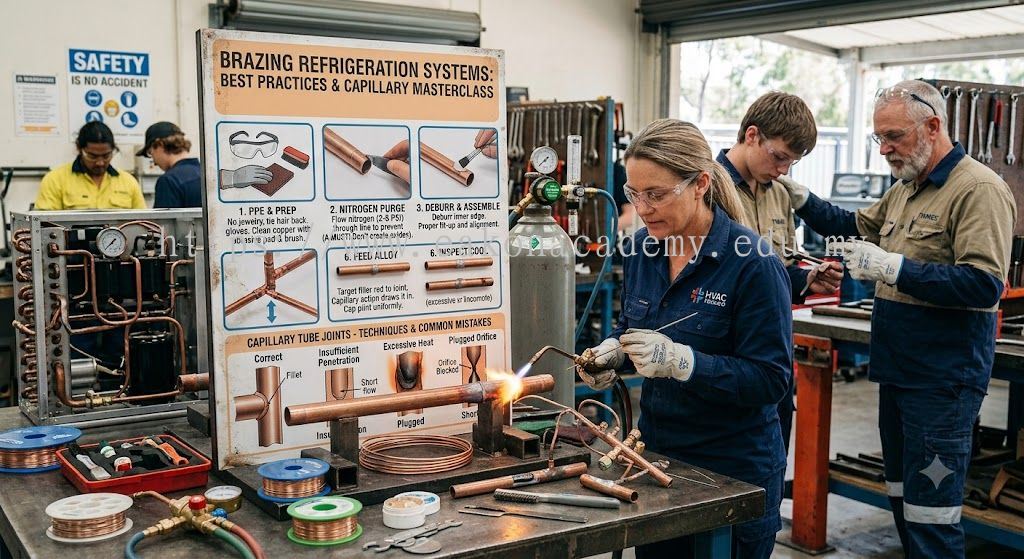
HVAC Refrigeration Brazing Best Practices Guide – Professional Copper Pipe Joining Standards for Safe and Efficient Cooling System Installation
The HVAC refrigeration brazing best practices guide is a comprehensive technical reference that outlines the industry-approved methods for joining copper pipes in refrigeration and air conditioning systems. This guide is essential for HVAC professionals because brazing quality directly impacts system performance, refrigerant containment, energy efficiency, and long-term reliability. In modern HVAC installations, following best practices ensures that every joint is strong, leak-free, and capable of withstanding high pressure and temperature variations. At Eakon Academy, this guide is an integral part of structured training programs designed to develop skilled technicians who meet professional industry standards.
The HVAC refrigeration brazing best practices guide begins with proper copper pipe preparation, which is the foundation of all successful brazed joints. Technicians must ensure accurate measurement and clean cutting of copper tubing using professional pipe cutting tools to avoid deformation and uneven edges. After cutting, both internal and external burrs must be removed carefully to maintain smooth refrigerant flow and proper fitting alignment. Cleaning is a critical best practice, requiring copper surfaces to be thoroughly treated using emery cloth or abrasive materials to remove oxidation, oil, and contaminants. This ensures optimal metallurgical bonding during brazing and prevents future leakage or performance issues.
Another key best practice in the HVAC refrigeration brazing best practices guide is correct fitting alignment and capillary gap control. The copper pipe must be inserted into the fitting at the correct depth to maintain a uniform capillary gap around the joint. This gap allows molten brazing filler metal to flow evenly during heating, forming a complete and strong seal. Proper alignment is essential in refrigeration systems because even minor installation errors can result in refrigerant leakage, pressure loss, or reduced system efficiency.
Nitrogen purging is also a critical industry best practice. During brazing, a controlled flow of nitrogen gas must be introduced into the piping system to prevent internal oxidation caused by high temperatures. Without nitrogen purging, scale formation can develop inside copper pipes, leading to reduced cooling performance, restricted refrigerant flow, and potential damage to key HVAC components such as compressors, expansion valves, and filters. This practice is widely recognized as essential for maintaining clean internal pipe conditions and ensuring long-term system reliability.
The heating process is another important focus of best practices. Technicians must use an oxy-acetylene torch with a properly adjusted neutral flame to ensure even heat distribution across the joint area. Temperature must be carefully controlled within the recommended brazing range of 600°C to 650°C. Skilled technicians observe copper color changes to identify the correct moment for filler rod application, ensuring optimal bonding conditions.
The brazing filler rod must be applied correctly, allowing it to melt through base metal heat rather than direct flame contact. This ensures proper capillary action, enabling the molten alloy to fully penetrate the joint and create a strong, leak-free seal suitable for refrigeration systems.
After brazing, best practices require natural cooling without forced air or water to prevent thermal stress. Final inspection includes visual checks, pressure testing, and leak detection to ensure system integrity before commissioning.
In conclusion, the HVAC refrigeration brazing best practices guide at Eakon Academy provides essential knowledge for HVAC professionals. It equips learners with the technical expertise and practical skills required to consistently perform high-quality copper brazing work, ensuring safe, efficient, and long-lasting refrigeration and air conditioning system performance that meets modern industry standards.
More detail about EAKON ACADEMY SDN BHD Malaysia
