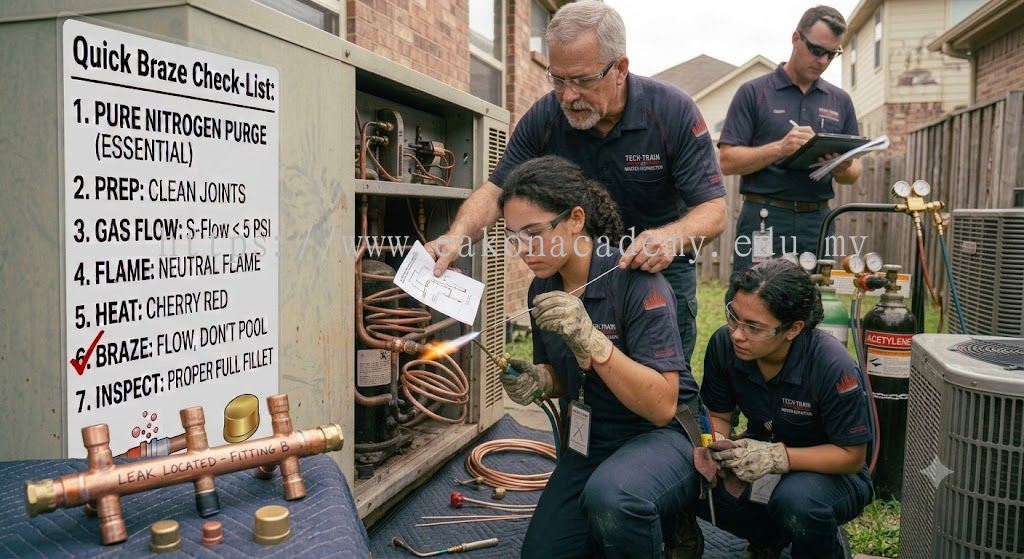
OXY ACETYLENE BRAZING HVAC BEST PRACTICES FOR PROFESSIONAL COPPER PIPE JOINING AND REFRIGERATION SYSTEM RELIABILITY
Oxy acetylene brazing HVAC best practices represent the industry-standard methods and procedures used by professional technicians to ensure high-quality, safe, and durable copper pipe joints in refrigeration and air conditioning systems. These best practices are essential for achieving strong brazed connections that can withstand high pressure, vibration, and temperature fluctuations commonly found in HVAC-R applications. At eakonacadem.edu.my, learning these best practices is a core part of HVAC training, designed to prepare students and technicians with the skills needed to deliver reliable, efficient, and long-lasting installations in real-world working environments.
One of the most important oxy acetylene brazing HVAC best practices is proper preparation of copper pipes before brazing begins. This includes accurate measurement, cutting, and deburring of copper tubing to ensure clean and smooth edges. All pipe surfaces must be thoroughly cleaned to remove oil, dirt, and oxidation, as contaminants can weaken the brazed joint. Correct pipe alignment and proper joint spacing are also critical to allow capillary action to distribute the brazing filler metal evenly throughout the joint, resulting in a strong and uniform bond.
Another key best practice is correct setup and inspection of oxy acetylene equipment. Technicians must ensure that oxygen and acetylene cylinders are properly secured, regulators are correctly installed, and hoses are free from leaks or damage. Flashback arrestors should always be used to prevent dangerous reverse gas flow. Before ignition, all connections must be checked to ensure safe operation. Proper equipment handling is essential for maintaining both safety and brazing quality in HVAC applications.
Flame control and heat management are central to oxy acetylene brazing HVAC best practices. Technicians must learn to adjust the torch to achieve a neutral flame, which provides balanced combustion and minimizes oxidation on copper surfaces. Proper heat application ensures that the brazing filler material flows smoothly into the joint through capillary action. Overheating can damage copper pipes and weaken system integrity, while insufficient heat can lead to weak or incomplete bonding. Skilled HVAC technicians must maintain consistent torch movement and controlled heating techniques to achieve optimal results.
Nitrogen purging is another essential best practice in HVAC oxy acetylene brazing. During the brazing process, nitrogen gas is introduced into the internal piping system to prevent oxidation and scale formation inside copper tubes. This ensures internal cleanliness, smooth refrigerant flow, and protection of critical HVAC components such as compressors, evaporators, and expansion valves. Without nitrogen purging, internal contamination can significantly reduce system efficiency and cause long-term operational issues. This practice is widely taught at eakonacadem.edu.my as part of professional HVAC standards.
Safety is a fundamental component of oxy acetylene brazing HVAC best practices. Technicians must wear appropriate personal protective equipment, including safety goggles, heat-resistant gloves, and flame-resistant clothing. Proper ventilation is required to ensure a safe working environment. Understanding flame behavior, gas handling procedures, and emergency shutdown protocols is essential for preventing accidents and ensuring safe operations during brazing work.
Post-brazing inspection is also an important best practice. After the joint has cooled, technicians must visually inspect the brazed area to ensure proper coverage, smooth finish, and structural integrity. Leak testing is then performed to confirm system tightness before commissioning. This ensures that the HVAC system operates efficiently and safely without refrigerant loss.
Oxy acetylene brazing HVAC best practices directly contribute to system reliability, energy efficiency, and long-term performance. Properly brazed joints reduce refrigerant leakage, improve pressure stability, and enhance overall cooling efficiency. This results in lower maintenance costs, reduced energy consumption, and extended equipment lifespan, making it a critical skill in the HVAC industry.
By mastering oxy acetylene brazing HVAC best practices, learners gain a strong professional advantage in the HVAC-R field. Through structured training and hands-on experience at eakonacadem.edu.my, students develop the technical expertise required to deliver high-quality refrigeration and air conditioning systems that meet international industry standards and expectations.
More detail about EAKON ACADEMY SDN BHD Malaysia