
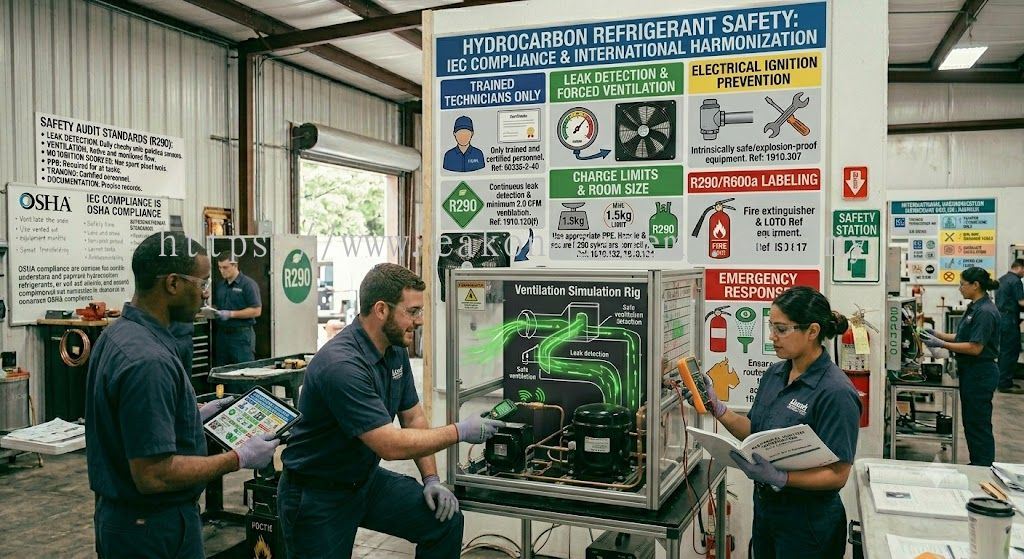
HYDROCARBON REFRIGERANT IEC SAFETY STANDARDS FOR SAFE, COMPLIANT, AND HIGH-QUALITY HVAC-R SYSTEM DESIGN AND OPERATION
Hydrocarbon refrigerant IEC safety standards are internationally recognized electrical and technical guidelines developed by the International Electrotechnical Commission (IEC) to ensure the safe use of hydrocarbon (HC) refrigerants such as propane (R290) and isobutane (R600a) in HVAC-R systems. As the global HVAC industry continues to transition toward environmentally sustainable refrigerants with low global warming potential (GWP), hydrocarbon refrigerants are widely adopted due to their high energy efficiency, strong cooling performance, and minimal environmental impact. However, because HC refrigerants are classified as flammable substances, IEC safety standards are essential to ensure safe system design, installation, electrical protection, and operational control. At eakonacadem.edu.my, we provide professional HVAC education and technical training that supports the correct understanding and application of hydrocarbon refrigerant IEC safety standards for industry professionals.
Hydrocarbon refrigerant IEC safety standards provide a structured framework for managing electrical and mechanical risks associated with flammable refrigerant systems. These standards cover important areas such as system design requirements, refrigerant charge limits, electrical safety regulations, equipment selection, installation procedures, ventilation control, leak prevention, and maintenance practices. By following IEC guidelines, HVAC professionals can ensure that hydrocarbon refrigerant systems operate safely, efficiently, and in compliance with international safety expectations.
One of the key focuses of IEC safety standards is electrical system protection in hydrocarbon refrigerant applications. Since HC refrigerants are flammable, electrical components must be designed and installed to prevent sparks, overheating, or electrical faults that could lead to ignition. IEC standards specify requirements for insulation, grounding, circuit protection, and safe electrical enclosure design. These measures significantly reduce the risk of fire or explosion in HVAC-R systems.
System design and engineering safety are also critical components of hydrocarbon refrigerant IEC safety standards. Engineers must ensure that refrigerant charge limits, equipment placement, and system configuration are properly designed to prevent hazardous refrigerant concentrations in case of leakage. IEC guidelines help ensure that HVAC systems are engineered with safety as a primary consideration while maintaining high energy efficiency and performance.
Equipment selection is another important requirement under IEC standards. All components used in hydrocarbon refrigerant systems, including compressors, heat exchangers, valves, sensors, and electrical control systems, must meet specific safety and performance criteria. Using IEC-compliant equipment ensures reliability and reduces the likelihood of system failure or safety hazards.
Installation procedures must also follow IEC safety requirements. Technicians must ensure proper piping installation, secure connections, leak-free joints, and accurate system pressure testing. High-quality installation is essential for preventing refrigerant leakage, which could create flammable conditions when combined with ignition sources.
Ventilation requirements are also addressed in IEC safety standards. Adequate airflow must be provided in all areas where hydrocarbon refrigerant systems are installed. Proper ventilation helps prevent the accumulation of flammable gases and ensures safe operating conditions, especially in enclosed or semi-enclosed environments.
Leak detection and maintenance procedures are also key elements of IEC compliance. Regular inspection, testing, and preventive maintenance help identify potential issues early and ensure that systems remain safe and efficient throughout their operational life. Proper maintenance also reduces refrigerant emissions and supports environmental sustainability.
Technician training and competency are essential for achieving IEC compliance. HVAC professionals must be trained in flammable refrigerant safety, electrical protection principles, and proper installation techniques. Skilled technicians play a vital role in ensuring that IEC standards are correctly applied in real-world HVAC-R systems.
At eakonacadem.edu.my, we emphasize the importance of professional HVAC education related to hydrocarbon refrigerant IEC safety standards. Through structured training and practical learning, technicians can develop the knowledge and skills required to safely work with modern refrigerant technologies while meeting international safety requirements.
Furthermore, adherence to IEC safety standards supports global sustainability goals by enabling the safe adoption of low-GWP refrigerants. Hydrocarbon refrigerants provide significant environmental benefits when properly managed through correct engineering, installation, and maintenance practices.
In conclusion, hydrocarbon refrigerant IEC safety standards are essential for ensuring safe, efficient, and compliant HVAC-R system operation. By following proper requirements for electrical safety, system design, equipment selection, installation, ventilation, maintenance, and technician training, HVAC professionals can maximize system performance while minimizing risks. This comprehensive approach strengthens HVAC education and makes it a key focus area for training platforms like eakonacadem.edu.my.
More detail about EAKON ACADEMY SDN BHD Malaysia
