
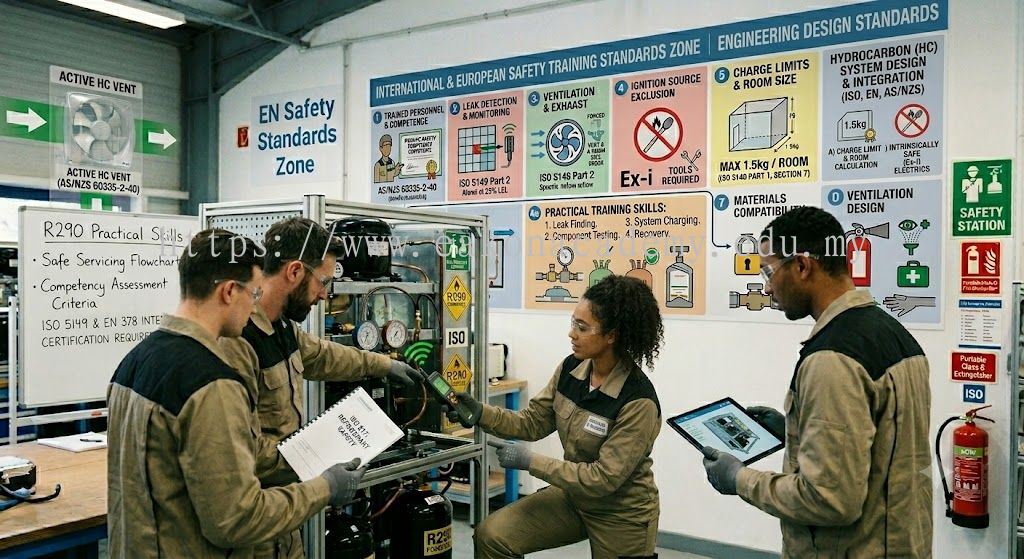
HYDROCARBON REFRIGERANT ENGINEERING SAFETY STANDARDS FOR ADVANCED HVAC-R SYSTEM DESIGN, INSTALLATION, AND OPERATION
Hydrocarbon refrigerant engineering safety standards are essential technical principles that guide engineers, designers, and HVAC-R professionals in developing safe, efficient, and reliable refrigeration and air conditioning systems using hydrocarbon (HC) refrigerants such as propane (R290) and isobutane (R600a). As the HVAC industry continues to move toward sustainable refrigerant technologies with low global warming potential (GWP), hydrocarbon refrigerants have become an important solution due to their excellent thermodynamic performance, energy efficiency, and reduced environmental impact. However, because HC refrigerants are classified as flammable refrigerants, engineering safety standards are required to control risks related to system design, refrigerant charge management, equipment selection, ventilation, electrical safety, and operational procedures. At eakonacadem.edu.my, we provide professional HVAC education and technical training that supports the correct application of hydrocarbon refrigerant engineering safety standards for modern HVAC-R professionals.
Hydrocarbon refrigerant engineering safety standards focus on a complete engineering approach that considers safety from the initial design stage through installation, commissioning, operation, and maintenance. Proper engineering practices ensure that HVAC-R systems using flammable refrigerants can achieve high performance while maintaining safe operating conditions. These standards help engineers develop systems that minimize refrigerant leakage risks, prevent ignition hazards, and improve long-term reliability.
One of the most important aspects of engineering safety standards is proper system design evaluation. Engineers must consider refrigerant type, system capacity, refrigerant charge limits, equipment location, and application requirements before developing a hydrocarbon refrigerant system. Accurate calculations and careful planning help ensure that refrigerant concentrations remain within safe limits during normal operation and potential leakage situations.
Refrigerant charge management is another critical area within hydrocarbon refrigerant engineering safety standards. Since HC refrigerants are flammable, controlling the amount of refrigerant contained within a system is essential. Engineers must design systems with appropriate refrigerant quantities while maintaining cooling performance and energy efficiency. Proper charge management reduces safety risks and supports compliance with technical requirements.
Equipment selection and system compatibility are also major engineering considerations. Components such as compressors, heat exchangers, expansion devices, sensors, electrical systems, and safety controls must be suitable for hydrocarbon refrigerant applications. Engineers must evaluate component performance, reliability, and safety characteristics to ensure that the complete HVAC-R system operates effectively.
Ventilation engineering is another important element of hydrocarbon refrigerant safety. Engineers must consider airflow design, equipment placement, and room characteristics to prevent refrigerant accumulation in the event of leakage. Proper ventilation strategies help maintain safe operating environments and reduce the possibility of reaching flammable refrigerant concentration levels.
Electrical safety engineering is also a key requirement. Because HC refrigerants can ignite when exposed to sparks or electrical faults, engineers must carefully evaluate electrical system design. This includes selecting suitable electrical components, ensuring proper protection systems, and designing installations that reduce potential ignition sources.
Safety controls and monitoring systems are also important components of modern hydrocarbon refrigerant engineering. Engineers may incorporate leak detection sensors, safety alarms, pressure protection devices, and automatic shutdown systems to improve operational safety. These systems provide additional protection and help identify abnormal conditions quickly.
Commissioning and validation procedures are essential after system installation. Engineers and technicians must verify system performance, refrigerant charge accuracy, leak tightness, pressure conditions, temperature control, and safety functions. Proper commissioning ensures that the system operates according to the original engineering design.
Maintenance planning is another important part of engineering safety standards. HVAC-R systems using hydrocarbon refrigerants require structured maintenance procedures to ensure continued safety and efficiency. Regular inspections, leak detection, component checks, and performance evaluations help maintain system reliability throughout its operational lifespan.
At eakonacadem.edu.my, we emphasize the importance of professional training in hydrocarbon refrigerant engineering safety standards. Proper education enables HVAC professionals to understand engineering principles, safety requirements, and practical implementation methods for sustainable refrigerant technologies.
Furthermore, applying engineering safety standards supports environmental responsibility by reducing refrigerant emissions, improving energy efficiency, and promoting sustainable cooling solutions. Hydrocarbon refrigerants provide significant environmental benefits when properly designed, installed, and maintained according to professional engineering practices.
In conclusion, hydrocarbon refrigerant engineering safety standards are fundamental for creating safe, efficient, and sustainable HVAC-R systems. Through proper engineering design, charge management, equipment selection, ventilation planning, electrical safety, commissioning, and maintenance procedures, professionals can maximize the advantages of hydrocarbon refrigerants while minimizing operational risks. This comprehensive approach strengthens HVAC education and makes it a key focus area for training platforms like eakonacadem.edu.my.
More detail about EAKON ACADEMY SDN BHD Malaysia
